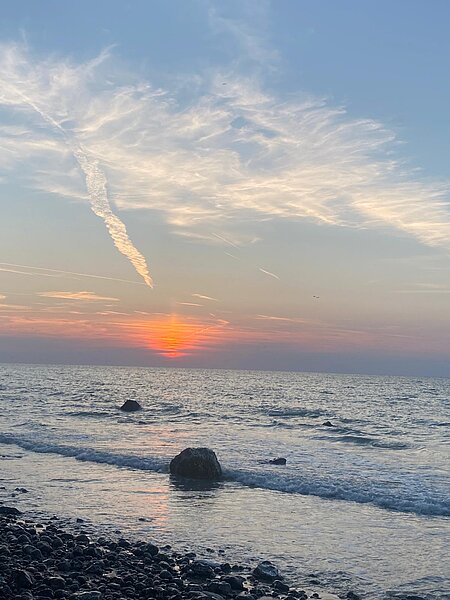
Why Den Helder suddenly became more important than Scheveningen, why Helgoland turned into a gas station paradise, and why Dieppe is the perfect place to take a breather—you’ll find all of that in the report on the first leg. The journey is the adventure. And it’s only just begun.
We made it. And as is so often the case, everything turned out exactly as it was meant to: exciting, thrilling, sometimes too warm, sometimes too cold, glorious, wonderful—and, of course, exhausting. One of those stages you don’t plan, but simply experience.
But let’s start from the beginning.
It all begins in Neustadt. Or rather: it was supposed to begin on July 1. However, the weather had other plans, as did a generator that refused to cooperate. Various last-minute attempts at repairs failed spectacularly. So: a new start on July 4—slightly delayed, but at least full of optimism.
Given the weather conditions and the forecast storms in the Kattegat, we made a decision that would later prove to be absolutely the right one: set course for Kiel and through the Kiel Canal. In retrospect, it was a stroke of luck—not only in terms of the weather, but also as a gentle acclimatization for both crew and equipment.
After all, the first few miles on a boat that’s new to me are like getting to know someone for the first time: you feel your way cautiously, discover its quirks—and little oddities. It quickly becomes clear: the generator has a mind of its own, parts of the rigging need replacing, and the boat seems to be gently reminding us that it still needs a little attention. Below deck, there’s a flurry of activity: organization is in full swing. Fire extinguishers and smoke detectors are being installed, cabinets are being secured for the sea, and everything is slowly finding its place.
And so we reach Cuxhaven—safe, content, and with the feeling that everything is slowly falling into place. Even here, we’re greeted by curious seals, who watch us with their dark, beady eyes, as if to test whether we’re even ready for the adventure on the North Sea.
From there, we head out onto the open North Sea, setting course for Heligoland. A special moment: our first time truly out on the open sea. The seagulls accompany us for quite a while, seemingly always on the lookout for a little snack or simply out of pure curiosity. And then they surface—the first porpoises. For just a few seconds, their backs break the surface of the water before they disappear silently again. If you’re not paying attention, you’ll miss them right away. That’s exactly why every sighting feels like a little gift.
Helgoland welcomes us with its rugged charm—and even more animal inhabitants. On the sandbars surrounding the island, harbor seals and gray seals bask in the sun, completely unfazed by the people, while above us the seagulls loudly debate who gets the next fish. We, on the other hand, are busy with far more mundane matters: 2,000 liters of tax-free diesel go into the tank. The weather forces us to take a two-day break, which we use to tackle our next repair project: the generator needs professional help. So we arrange for repairs in the Netherlands, our next destination.
With a half-wind from the northwest, we set sail—two days and one night. The plan was actually to head to Scheveningen. But just before Den Helder, the engine starts acting up again. A slight tremor runs through the crew—and the ship. The question hangs in the air: Will we still make it to the harbor?
We decide on Den Helder. Better safe than sorry. And sometimes “Plan B” is simply the better story.
Three days later, we continue on to Scheveningen. There, Paul steps in—a sort of maritime wizard—and brings the engine and generator back to life. A moment that feels almost like a fresh start.
The next leg is ambitious: all the way to Le Havre. A full day of sailing, a quiet night—everything is going smoothly. Once again, seagulls accompany us, and out on the open North Sea, porpoises keep appearing. They seem to accompany the ship for a brief moment before disappearing silently into the distance. Encounters like these remind us that we’re just guests here.
Then, on the morning of the second day: a lull. Absolute stillness. The sea becomes as smooth as glass, and we switch from sailing to motor power. That’s how we finally reach Dieppe in Normandy. Just before the French coast, a porpoise even makes an appearance once more—almost as if it wanted to welcome us to the English Channel.
Dieppe is a small, beautiful town, over a thousand years old, with plenty of charm and history. A place that feels as though it has time to spare.
This is where the first leg ends.
A week-long break—to catch our breath, make repairs, do laundry, restock supplies, and let all the experiences sink in. Because one thing is already clear: The journey is still young, but it has long since begun to write its own stories.